
University of New England students participate in nature-based shoreline stabilization effort
 |
|
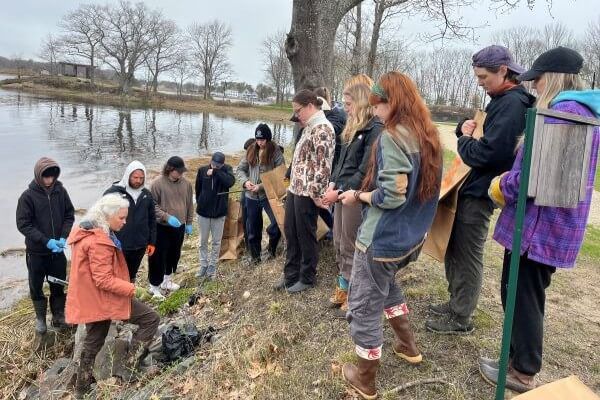
Students gather around University of New England Professor Pam Morgan (in the orange jacket) during a project along the Saco River on Wednesday. PHOTO BY LIZ GOTTHELF
|
Sat, May 2, 2026 |
Students at University of New England got some hands-on experience in a living shoreline project that will protect the college’s shoreline for future students.
About 20 students from Professor Jennifer Brousseau’s Climate Change Adaptation class were on the banks of the Saco River on Wednesday morning at the Biddeford campus. The students were removing invasive species including bittersweet and honeysuckle, one of the first steps in a “living shoreline” project along the cove spanning Jordan Point and Hills Beach Road.
“It helps the campus, and it’s our way of giving back,” said Brousseau.
A living shoreline uses natural material like plants instead of artificial materials like seawalls to help stabilize the waterfront.
The students last week were prepping the area so that new vegetation can be planted in the future.
Environmental Studies Professor Pam Morgan said shrubs that are tolerant of salt water will be planted along the shore of the river, and the roots will hold the riverbank in place. Logs will be anchored down with cables in the marsh, providing a natural barrier as the area behind the logs is filled with sediment and marsh grass is planted.
As the marsh grass grows, the roots will spread and stabilize the sediment, said Morgan. The grass will eventually grow over the logs, which will disappear under the grass, she said.
Living shorelines are a rather new method in Maine, and there aren’t a lot of examples of them in the state, said Morgan. As people learn more about living shorelines, she hopes that they will be used instead of methods like seawalls, which shield the area in front of them, but can cause worse erosion off to the sides as they deflect wave energy.
“We’re really hoping that this could be a place where people could come and see what’s happening here and learn about living shorelines,” she said.
The University received a $138,400 grant from the Builders Initiative and the Broad Reach Fund for some of the preliminary work like planning, design and permitting, but is seeking more funding for materials and work for the final project.
“It’s exciting stuff,” said Morgan. Students will be involved in all parts of the project, and will monitor the shoreline for decades to come. They will also study the impact on clam populations and the invasive green crabs, she said.
“I think the nature-based solutions are important to consider,” said UNE Junior Edward Iannuzzi-Sucich, noting recent legislation in Maine promoting living shoreline projects.
“I think especially a university, as an academic institution, can serve as a model for what the community can implement. I think the project is spreading awareness of living shoreline solutions. It’s important that these solutions be implemented elsewhere,” he said.
Senior Bailey Gosse said that over the past four years on campus she’s seen the coast recede and impacts of major storms.
An environmental studies major with a minor in geographic information systems, Gosse said she’s studied the damage that could happen to the shoreline at UNE in 50 years if nothing is done.
She said as an environmental studies major, she hears a lot of “heavy news” and it’s easy to get what she calls “climate anxiety.” She said the living shoreline project gave her hope. She said it was nice to see students be part of something that will have an impact on the campus, so that students and community members can continue to use the walkways and enjoy the campus.
Saco Bay News Publisher Liz Gotthelf can be reached at newsdesk@sacobaynews.com.