
Traffic calming project slated for Main Street in Saco
 |
|
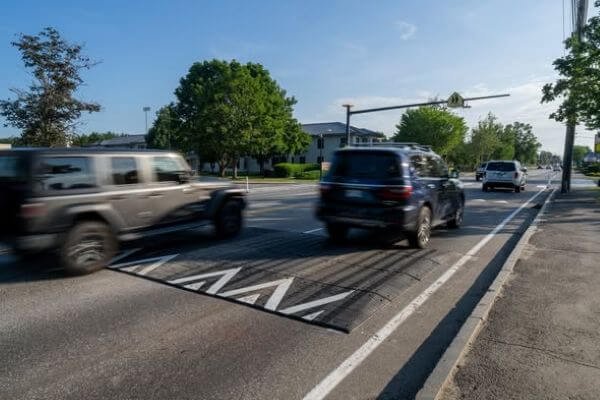
A traffic calming project in 2025 in Saco can be seen in this photo courtesy of the City of Saco Facebook page. A second project is scheduled late this month.
|
Wed, Jun 3, 2026 |
As some who support safer streets will point out, if streets are made safer for pedestrians and bicyclists, they’re safer for everyone.
That’s the goal of an $800,000 Safe Streets for All grant awarded to the Greater Portland Council of Governments in 2024. With the funding, GPCOG proposed to stage 17 demonstration projects in the southern Maine region, including three in Saco.
In 2025, temporary speed tables were installed near the Main Street crosswalk providing access to Thornton Academy’s primary entrance. The demonstration project was a success – traffic speeds were found to be 5 miles per hour slower on average with the speed tables in place -- and will lead to a permanent installation later this year.
A second project, which is slated for this month, calls for realigning and improving crosswalks and creating painted medians within the section of Main Street from Cutts Avenue south to Water Street, changes that are anticipated to result in safer conditions for pedestrians.
In 2027, Saco will see a third project, the details of which are yet to be determined.
For this year, City and GPCOG staff identified Main Street as a “critical safety corridor,” pointing to the high rate of crashes, particularly crashes involving pedestrians and bicyclists. While sidewalks exist and are utilized, the street’s design “puts it at risk for more future crashes,” according to a presentation done by Cashel Stewart, a transportation planner with GPCOG at the May 18 City Council meeting.
Why demonstration projects, rather than simply installing new crosswalks or curb, pedestrian signals or raised medians? Stewart offered these talking points:
• Low-cost but high impact
• Often seasonal, but the benefits are 24/7 traffic calming
• Safety-oriented
• Easily installed
• Easily reversible, if necessary
The effort is a collaboration of the Federal Highway Administration, which awarded the grant, the Maine Department of Transportation, the Bicycle Coalition of Maine and other consultants who are tapped as needed, Stewart told the council.
In conjunction with city staff, the demonstration project is intended to, improve the safety of pedestrian crossings, narrow the east end of the now one-way Cutts Avenue to make it a safer crossing for pedestrians, reduce vehicle speeds, and improve sightlines for vehicles and visibility of pedestrians.
Specifically, residents and business owners – who have been or will be contacted prior to the project rollout the week of June 29 – will see:
a) Cutts Avenue – painted, striped lines and 36-inch-high plastic posts will be used to expand the “bump-outs” on both south and north sides of Cutts Avenue where it intersects Main Street. The bump-outs were installed several years ago to shorten the distance for crossing Cutts. More recently, Cutts was turned into a one-way street, allowing for the demonstration bump-outs to extend further into the street, while leaving a 20-foot-wide lane for entering vehicles, a much shorter for pedestrians to cover from corner to corner.
Also, the existing crosswalk between the corner of Cutts and Main across Main Street to the corner of School and Main is at an angle that lengthens the distance for those crossing Main Street. The crosswalk will be painted over and a new crosswalk angled at 90 degrees will deliver users to a temporary curb ramp on the east side of Main Street. The curb ramp and pedestrians will be protected by a painted stripes and plastic posts zone; a single parking spot will be eliminated as a result.
b) Further south along Main Street a temporary, painted median strip will be installed running north from the existing crosswalk along the middle of the street to a point opposite the corner of Free Street. Three-foot-high yellow flex posts will be installed to create a “refuge” point for those crossing the street. Also, a painted, white-striped box will be installed with the goal of discouraging motorists from sitting within the box during stoppages for train crossings, so that those exiting Storer Street will have a chance to turn left and proceed north on Main Street.
c) Crosswalks at Water and Main streets will be left as is. A painted yellow median will narrow the northbound lane to 11 feet, while once again providing a bit of refuge to those crossing on foot through the use of three-foot yellow flex posts.
During the three-plus month installation, the agencies will be collecting traffic data pertaining to speed, volume, pedestrian yield studies – how long must a pedestrian stand at a crosswalk until vehicles stop for him or her or them – and crash data and severity.
Councilor Nathan Johnston, a supporter of bicycle and pedestrian improvements, was enthusiastic about the project.
“I think it’s great to see how this will work,” he said. The Ward 7 councilor led an effort – approved unanimously -- on May 11 to amend the proposed city budget for FY27 by transferring $200,000 from the “unassigned fund balance” to the “committed fund balance – infrastructure” “to support future active transport transit human powered projects” as determined by the Council. Whether Johnston and the Council have a specific project in mind or are open to suggestions from staff and public is yet to be determined.
Police Chief Jack Clements asked how the data would be gathered, and was told that standards set forth by the National Association of City Transportation Officials would be followed.
Bob Hamblen is a freelance writer from Saco. He can be reached at rhh0918@gmail.com.