
Squirrels are the subject of University of New England study
 |
|
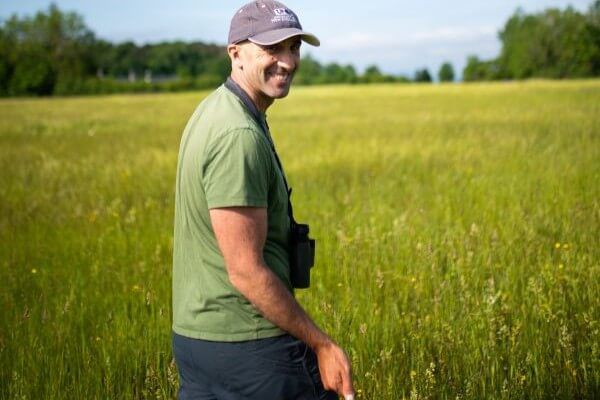
Noah Perlut heads Project Squirrel at the University of New England. COURTESY PHOTO
|
Sat, Nov 15, 2025 |
Dr. Noah Perlut, an ornithologist at the University of New England, never would have expected when he started out in academia that he would be known as a squirrelologist.
In 2011, he found himself at a professional crossroad after his bird study ideas didn’t go according to plan.
“When I came to UNE, I started to teach this class called Conservation and Preservation Field Lab,” Perlut said. “I wanted to create a lab where we could walk outside and study a wildlife species in the same way that either a graduate student or professional biologist would study, using some kind of field technique. And as part of that, I started thinking about different birds that this would work with.”
He mulled over ideas for a suitable subject on campus. “I kind of ran out of my bird ideas and just started thinking about what animals that not only are common here on campus, but throughout the whole fall and spring semesters,” he recalled. “And I thought, well, maybe gray squirrels would be a good species to study.”
Choosing to study squirrels could make more of an impact than he first realized. At the time, Perlut was shocked to learn that he could not find a single ecological study published on gray squirrels in New England.
“There were a few behavior studies on things like cashing behavior,” he said.
“But as far as understanding the most basic things of how long they live, how much space they use… that’s the most basic ecology of a species” – he found nothing.
Inspired, he made the leap.
“I decided to go to the dark side of mammology instead of ornithology and start this project,” he said.
Thus, “Project Squirrel” was born. What began as a simple field lab has since transformed into a little over a decade-long ecological study that has tracked approximately 175 squirrels around UNE, unraveling the complex behavior of these common bushy-tailed creatures.
The project’s methods have evolved through the years; starting with ear tags and switching over to radio telemetry.
The ear tags had some flaws.
“Sometimes squirrel’s nest mates can pull the tags out of their ears,” Perlut said, also noting, “there’s a lot of squirrels and they’re hard to follow by foot.” The solution was radio telemetry.
“We catch squirrels, we ear tag them, we measure them, we identify if they are male or females, we put these collars on them, and then the students spend this semester tracking them,” said Perlut.
The collars emit a beep that progressively gets louder when close, which students like Environmental Science Majors Gianna Rodriguez and Wes Barker track across campus with receivers. Using a GIS software, students merge their ground-level data with satellite information.
Perlut discovered the average squirrel’s home range is around six to eight acres, with some outcasts covering up to 70 acres.
“Which is huge and really fascinating because these are tiny animals that are food for other animals,” said Perlut.
More than just mapping movements, the project has revealed unusual squirrel personalities, risk-taking in particular.
“Going out and eating trash is risky behavior… This one is willing to take that risk, where the other ones aren’t,” he says, discussing a recently collared squirrel named Poppy.
The research has also shut down common myths, including the popular misconception that squirrels are dumb.
“It has nothing to do with the intelligence of squirrels. They’re pretty brilliant at what they’re doing,” he said, noting their incredible spatial memory for buried nuts.
“They are incredibly sociable,” he said, discussing how most chasing is playful or related to mating, not aggression.
The project has documented surprising findings, like the time, “a squirrel had showed up in Arundel at someone’s bird feeder,” making a significant trek from UNE’s campus in Biddeford, said Perlut.
For Perlut, the ultimate goal isn’t discoveries, instead it’s a shift in perspective.
“It’s not that I would want one discovery that we’ve made, more so that people become inspired to not put boundaries on what they think they know about these squirrels, that these squirrels are doing way more interesting things than we think they’re doing,” he said.
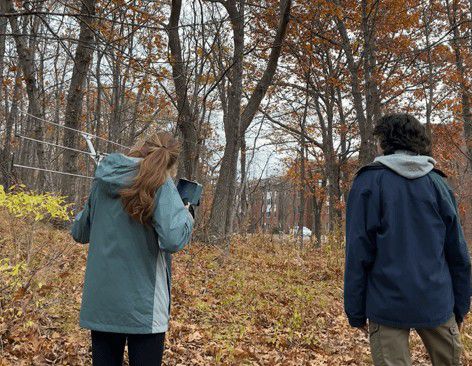 |
Noah Perlut’s students, Gianna Rodriguez and Wes Barker on the hunt for squirrels. PHOTO BY ANGELINA KEIZER |
Many students are intrigued by the unique project and related field study and coursework.
“The first time we caught a squirrel was pretty memorable, said sophomore Gianna Rodriguez.
Junior Wes Barker added, “Putting an ear tag in too was pretty cool.”
Rodriguez said Perlut is “very passionate about everything he teaches,” a driving force that keeps his students engaged.
Looking back on previous data from the years, Perlut reflects on the bigger picture, “So really just hopefully this project sort of inspires people’s curiosities about even common wildlife.”
Angelina Keizer is a student at University of New England and a UNE Community News Fellow.