
Invasive plants routed in never ending battle at Saco’s shore
 |
|
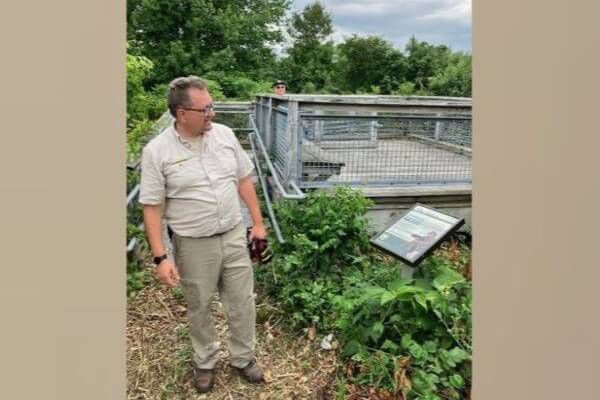
Tom Wall and senior volunteer Brad Peck take in the view at the Bill Silliker, Jr. observation platform. PHOTO BY BOB HAMBLEN.
|
Sat, Jul 19, 2025 |
Homeowners who maintain a lawn or do some gardening in hopes of outwitting the chipmunks and woodchucks know they’re got more than varmints to worry about: if American bittersweet or Japanese knotweed have slipped into the yard or introduced themselves to the ‘back 40,’ you can likely depend on many happy hours of pulling, snipping and digging in an effort to control these enemies that never sleep.
Seemingly anything that can be loosely called “soil” and receive rain and sun will facilitate the growth of these and other invasive plants. If you’re not personally familiar with these villains, just ask Thomas Wall, Visitor Services Manager with the Rachel Carson National Wildlife Refuge (NWR), headquartered in Wells.
He recently led efforts to re-establish a popular viewing point at Saco’s Goosefare Marsh, adjacent to Seaside Avenue/Route 9. The challenge? Removing umpteen cubic yards of invasive plant species from the 5.8 acre parcel at the corner of Goosefare Brook and the Atlantic Ocean.
Passersby as well as those visiting the observation platform at the Goosefare for the past several years can’t be blamed for wondering, “why a viewing platform to look at all this unmaintained flora?” After days of work, Wall and his crew were able to show off what lay beyond the dense wall of green: views of Goosefare Brook as it spills into the Atlantic, some of Maine’s finest beach system, and the gentle rollers lapping at the wet sands of Kinney Shores.
As Rachel Carson fans may know, the Refuge named for her was established in 1966 and called the Coastal Maine NWR. Carson passed in 1964, a victim of cancer; the refuge was renamed in her honor in October, 1969 and formally dedicated in June, 1970.
As described in Refuge literature, “…the refuge consists of ten divisions between Kittery and Cape Elizabeth.” Currently it includes about 5,600 acres of coastal wetlands, forested uplands, coastal meadows and more. When land acquisition is complete at some point in the future, a total of 7,600 acres of such lands will be owned and protected by the Refuge, a division of the U.S. Fish and Wildlife Service.
But back to the Goosefare.
Visitors to the popular viewing platform, dedicated as Silliker Outlook in 2004, in memory of Bill Silliker, Jr., a professional wildlife photographer who was a staunch advocate for the Goosefare and “special places” throughout Maine. He was integral to the effort in the late 1980s that staved off a large development on acreage adjacent to Goosefare Brook that resulted in the land’s acquisition by the federal government and the addition of hundreds of acres of land in Saco to the Refuge.
Locals and visitors this summer and beyond will have a number of parties to thank for revealing what lies beyond that solid green wall of unwelcome guests. In addition to the honeysuckle and knotweed, Autumn Olive, Rosa Rugosa, poison ivy and sumac are some of the other species taking over what has been a very hospitable site to many forms of vegetation according to Reyna, an invasive species intern from Kennebunk.
Wall is also assisted this summer by Patrick Cadogan, an intern studying psychology and environmental science at Trinity College in Hartford, Connecticut. Patrick’s assignment has been made possible by a grant received by the Friends of Rachel Carson National Wildlife Refuge, a non-profit that supports the Refuge’s mission.
On a hot day in late June, Tom and Patrick were on-site along with members of the Youth Conservation Corps (YCC), an intern, Cindy, a community engagement specialist from the Parker River National Wildlife Refuge in Newburyport, MA, and a University of Maine at Orono student studying wildlife ecology.
“These are all local kids,” said Wall, who is focused on establishing relationships with these and other sources of youngsters from nearby communities. “The YCC is a priority of the Refuge.” He added that the Refuge has partnered with the Northwoods Stewardship Center in East Charleston, Vermont for several years, which has provided interns and YCC participants.
He is also working with Apex Youth Connection in Biddeford, a nonprofit that supports young people in grades 5-12 through work on bicycles and encouraging productive lives. Apex was able to provide funding for hiring the crew leader, while the Refuge is covering the cost of hourly wages for crew members.
Most at the site that day were armed with clippers, rakes, tarps for hauling, saws and other gear for felling vegetation that reached as high as fourteen feet, dragging it out into the open and going back for more.
“We’ll cut, cut again towards fall, then spray the whole site with glyphosate,” said Wall, a Minnesota native whose previous assignment with the National Wildlife System was at the Rocky Mountain Arsenal NWR just north of Denver.
The plan called for cutting and storing the vegetation on site to let it dry out in the sun.
“We’re being pretty careful as to how we dispose of it,” said Wall. “We’ll let it die, then transport it off the site for disposal.” Wall made a point of suggesting that native plant donations appropriate to the site are welcome.
Reyna, an invasive species intern, noted that while the current effort has made a difference, it will be on ongoing struggle to stay ahead of all these species that seem to consider the coast of Maine an ideal habitat to put down roots and enjoy our quality of life.
“Last summer we were involved with the mechanical removal of invasives in the Mount A(gamenticus) area,” she said while watching co-workers pull yet another tarp loaded with freshly cut vegetation out into an open area for temporary storage.
She recalled the efforts of herself and others last year at Fort Foster, a historic town-owned facility in Kittery Point.
“Black swallow-wort was our target,” she said. The invasive is a perennial vine that can grow up to seven feet long in both sun and shade. "We had records from 2009 that reported four plants had been discovered there. When we visited yesterday, it was everywhere.”
The group’s efforts will continue the week of July 21: different tools, different goals.
“I will be out this week with a crew to work on the graffiti there with sanders and a generator,” said Wall. “The site has been a real project.”
Saco Bay Trails (SBT) volunteers are scheduled to meet Wall’s crew for the graffiti phase of the work, and in turn he’ll be bringing the Refuge’s “Planting for Pollinators” utility trailer to SBT’s “Fairy House Building Day” on July 26.
As this reporter expressed his thanks and said good-byes, Wall added a final positive to the efforts of so many to clear the site of invasives -- and other visitors.
“This is the first day I’ve been here that there weren’t people here ahead of us, smoking marijuana,” he said. An illegal campsite was also uncovered as the thick vegetation has been clipped and removed.
In the interest of full disclosure, the author of this article is a member of the board of directors of the Friends of Rachel Carson National Wildlife Refuge. The Friends look forward to this fall’s opening of a new Visitor Center at the Refuge on Brown Street in Kennebunk.
Bob Hamblen can be reached at rhh0918@gmail.com